West Germany Today (Rle: German Politics) by Karl Koch
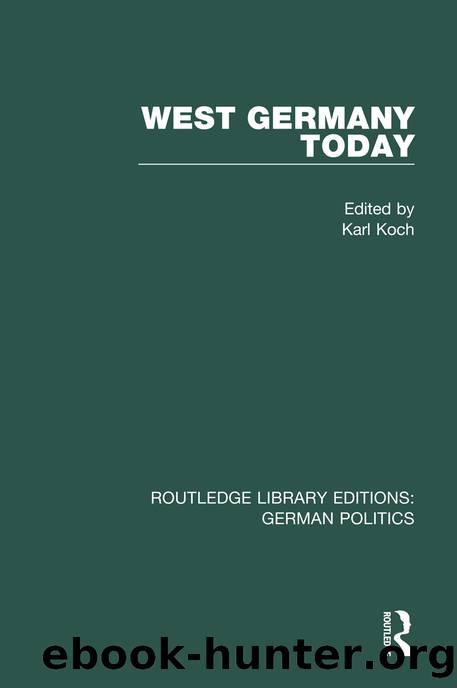
Author:Karl Koch [Koch, Karl]
Language: eng
Format: epub
ISBN: 9781138847682
Goodreads: 23062637
Publisher: Routledge
Published: 1989-08-10T00:00:00+00:00
Plant-level industrial relations
The implementation of the reduced working week was left to works councils and the managerial negotiations of each company. This focused interest on plant-level industrial relations and the West-German works council institutions.
The works council institution is, perhaps, one of the most characteristic features of the industrial relations system in West Germany. The works council as a form of employee participation and workplace regulator has had a long history in Germany; compulsory works councils date back to the Prussian mining industry in 1904. State legislation, covering large sections of German industry appears in 1916 (Hilfsdienstgesetz) as an emergency war measure. During Weimar, works councils appeared as part of the democratization process with the legislation of 1920 (Betriebsrätegesetz, 1920) but failed to establish a central role for themselves. The Weimar legislation did, however, feed into the famous Kontollratsgesetz Nr. 22 in the post-war era, which established works councils before the founding of the Federal Republic of Germany in 1949.
These historical strands were gathered by the first post-war Works Constitution Act of 1952 and amplified by the revised law of 1972. Central to the Works Constitution Act, 1972, is the peace obligation which can be interpreted from Article 2.1 of that law, which requires co-operation between works council and employer. The principle, enforced in this context, is that workplace industrial relations are based on a consensus and co-operative model; in effect the works council can neither initiate nor carry through overt industrial conflicts, for instance a strike.
As the works council was conceived by the legislators as an instrument of co-determination, that is employee participation in the decision-making process at plant level, it is not necessarily a contradiction to have a co-operative institution for this purpose. In terms of its co-determination function it has a range of rights: information rights, consultative rights, and, of course, genuine co-determination rights. On the other hand, in practice the works council has assumed the role of the main negotiating and conflict-resolving institution on behalf of employees. This does give it, in theory and in practice, an ambiguous role to play under certain circumstances. It should be emphasized that the role any particular works council may find itself playing depends on a host of factors: size of plant, workforce structure, technology, trade union density, and management attitudes amongst many others.
Although there is no compulsion to form a works council, which according to the Works Constitution Act is by election by all employees in a plant with five or more employees, there were, in September 1987, 64,165 works council members in the metal-working industry alone. The elections, which take place every three years, result in the establishment of works councils of various sizes: plants with, for example, a workforce of up to 2,000 have a works council consisting of 15 and plants with 12,000 one of 33. Where works councils consist of 9 or more members a number of works councillors are able to devote themselves to their function on a full-time basis.
As the law has provided clear categories of works council rights, its effectiveness does depend on the issues involved.
Download
This site does not store any files on its server. We only index and link to content provided by other sites. Please contact the content providers to delete copyright contents if any and email us, we'll remove relevant links or contents immediately.
| Anthropology | Archaeology |
| Philosophy | Politics & Government |
| Social Sciences | Sociology |
| Women's Studies |
The Secret History by Donna Tartt(19083)
The Social Justice Warrior Handbook by Lisa De Pasquale(12190)
Thirteen Reasons Why by Jay Asher(8907)
This Is How You Lose Her by Junot Diaz(6885)
Weapons of Math Destruction by Cathy O'Neil(6279)
Zero to One by Peter Thiel(5800)
Beartown by Fredrik Backman(5751)
The Myth of the Strong Leader by Archie Brown(5507)
The Fire Next Time by James Baldwin(5442)
How Democracies Die by Steven Levitsky & Daniel Ziblatt(5218)
Promise Me, Dad by Joe Biden(5153)
Stone's Rules by Roger Stone(5087)
A Higher Loyalty: Truth, Lies, and Leadership by James Comey(4959)
100 Deadly Skills by Clint Emerson(4924)
Rise and Kill First by Ronen Bergman(4788)
Secrecy World by Jake Bernstein(4751)
The David Icke Guide to the Global Conspiracy (and how to end it) by David Icke(4717)
The Farm by Tom Rob Smith(4506)
The Doomsday Machine by Daniel Ellsberg(4490)
